Is My Child Struggling With Reading — or Just Getting Started?
As a new school year begins, many parents find themselves watching their child's reading a little more closely.
Maybe your child is starting kindergarten and you're wondering whether they're ready to begin learning to read.
Maybe they're in first or second grade and still sounding out many of the words they encounter.
Or perhaps they're entering third or fourth grade and reading still seems to take a lot of effort. They may avoid reading, struggle to explain what they've read, have difficulty with spelling, or become overwhelmed by written assignments.
And you may find yourself wondering:
Is this just part of learning to read, or does my child need additional support?
As both an educator and a parent, I've learned that this question isn't always easy to answer.
I've been on both sides of this question
My daughter is now eight and beginning third grade, and our family has experienced many of the same questions and challenges that I hear from parents during consultations.
Second grade was difficult.
She was receiving reading intervention at school, and I want to emphasize that the intervention she received was fantastic. Her teachers and intervention team were working hard, and she was receiving thoughtful, appropriate support.
But as a parent, I could see that she needed more.
At home, homework became difficult. Reading and schoolwork could turn into frustration, and sometimes that frustration would spill into the rest of the evening. What started as a struggle over homework could become a struggle over bedtime.
And here I was—a special education teacher, reading interventionist, and someone who had spent years helping other families navigate these exact challenges.
My instinct was to try to do it all myself.
I wanted to be her parent.
I wanted to be her teacher.
I wanted to understand the data.
I wanted to provide the right practice.
I wanted to make sure she was getting everything she needed.
And eventually, I had to recognize something that I now tell parents often:
Sometimes our children need us to simply be their parent.
After thinking it through, talking with colleagues and other professionals, and seeking additional help, we found support outside of school that complemented what she was already receiving.
That additional support made a difference.
Today, she's making progress. She's gaining confidence. And one of the things that means the most to me as a parent is seeing her begin this new school year excited about reading and learning.
That experience changed the way I think about intervention.
More support doesn't mean something is wrong
One of the biggest misconceptions about reading intervention is that a child needs to be significantly behind before additional support is appropriate.
That's not necessarily true.
Sometimes a student needs more opportunities to practice a skill that is still developing.
Sometimes the school intervention is excellent—but the student needs additional time or intensity.
Sometimes the primary challenge isn't foundational decoding at all. A student may need support with spelling, reading accuracy, comprehension, vocabulary, written expression, or organizing and completing academic tasks.
The important question isn't simply:
“Is my child behind?”
It's:
“What does my child need right now to keep moving forward?”
Reading development isn't a race
Children don't all develop reading skills at exactly the same pace.
A child who needs additional practice doesn't necessarily have a significant reading disability, and a child who is struggling shouldn't necessarily be labeled based on one test or one difficult assignment.
What matters is understanding which skills are developing well and which ones may need additional support.
For example, a child may know their letter sounds but have difficulty putting those sounds together to read unfamiliar words.
Another child may be able to read individual words but struggle to read accurately and understand a passage.
Some children have relatively strong reading skills but struggle significantly with spelling and written expression.
And sometimes a child knows what they're capable of doing but has difficulty getting started, sustaining attention, or completing academic tasks independently.
These are different challenges—and they call for different approaches.
Third grade can bring a noticeable shift
This is something I think parents should be especially aware of as their children enter third grade.
As students move through elementary school, the academic demands of reading increase significantly.
Students aren't just learning how to read anymore.
They're increasingly expected to read to learn.
The texts become more complex. Vocabulary becomes more sophisticated. Students are expected to explain what they've read, make connections, answer questions using evidence, and communicate their thinking through writing.
A child who has managed to get by with some weaknesses in earlier grades may suddenly find that those weaknesses are much harder to compensate for.
That doesn't mean something suddenly went wrong.
It may simply mean that the demands have caught up with the skills that still need development.
What should parents watch for?
As the school year gets underway, pay attention to patterns rather than a single difficult day.
You might notice that your child:
Avoids reading or becomes frustrated quickly
Has difficulty reading unfamiliar words
Relies heavily on guessing rather than working through words
Reads accurately but very slowly or with significant effort
Has difficulty explaining what they just read
Has persistent difficulty with spelling
Struggles to organize or complete writing assignments
Needs much more help with schoolwork than you would expect for their age
Has lost confidence in themselves as a reader
None of these observations alone tells us exactly what is going on.
But they are good reasons to take a closer look.
You don't have to figure it out alone
This may be the most important lesson I've taken from my experience as both an educator and a parent.
We all want to do what's best for our children.
Sometimes that means helping with homework.
Sometimes it means talking with the teacher.
Sometimes it means asking more questions about assessment data or intervention.
And sometimes it means recognizing that another person may be better positioned to provide the support our child needs.
As parents, we don't have to do everything ourselves.
We just have to keep looking for what our child needs.
At Kangley Learning
That's the philosophy I bring to my work.
I don't believe every child needs the same reading program or the same type of intervention.
I start by trying to understand the student—their strengths, their challenges, the skills that are developing, and the skills that may be getting in the way of progress.
For some students, that means systematic foundational reading instruction.
For others, it may mean targeted work in reading accuracy, spelling, comprehension, vocabulary, written expression, or other literacy skills.
Sometimes a brief consultation and screening is enough to determine the next step. For other students, a more comprehensive assessment may be appropriate.
The goal isn't simply to give a child more work.
It's to give them the right work, at the right time, with the right level of support.
And hopefully, over time, something even more important happens.
They begin to experience success.
They begin to feel capable.
They begin to see themselves as readers and learners.
I've seen that happen with students throughout my career.
And I'm grateful to be seeing it happen in my own home, too.
If you've started the school year wondering about your child's reading, you're not alone.
Let's talk about your child's reading.
The Story of Kangley Learning
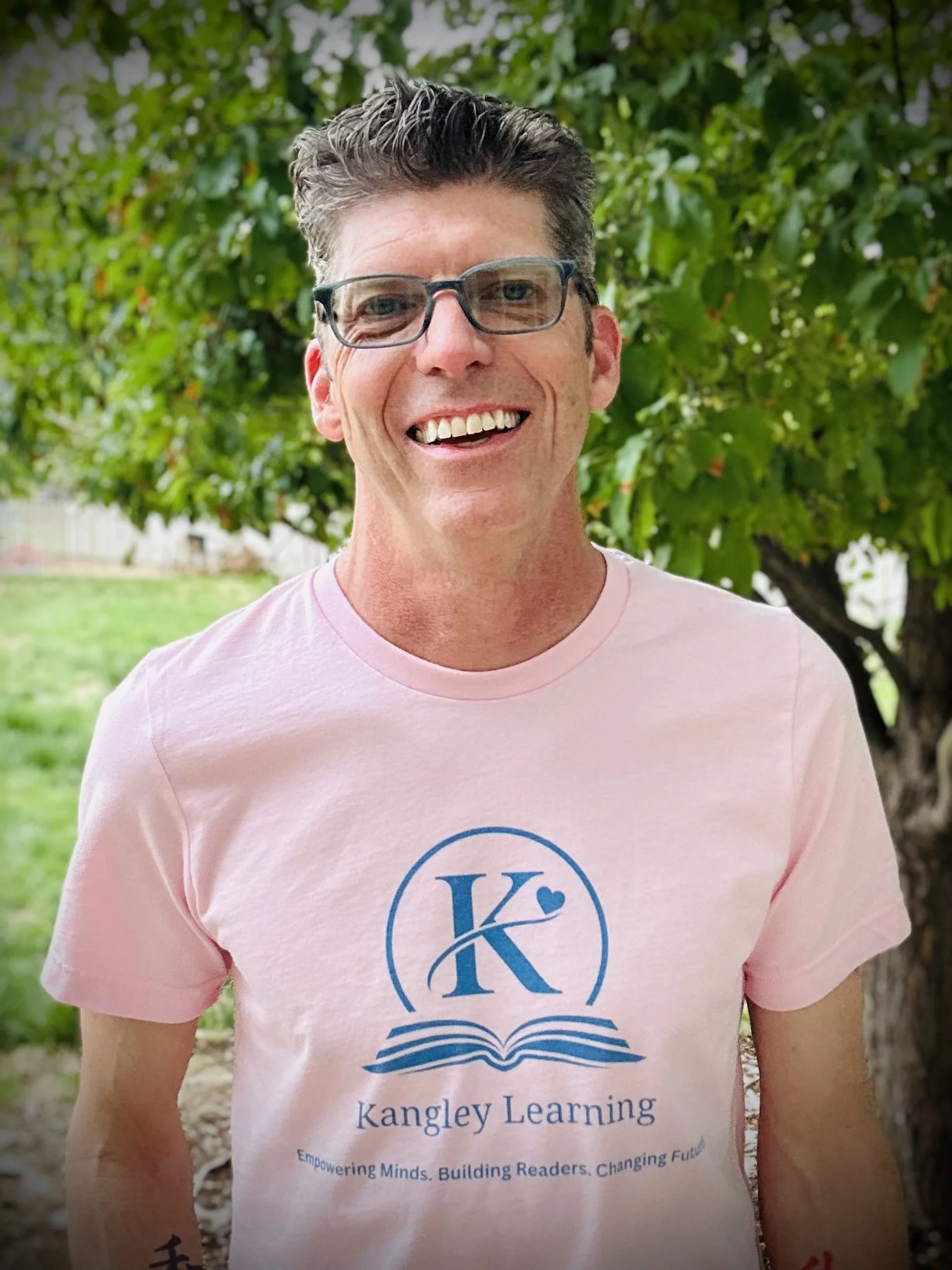
“Reading builds confidence, opens the world, and helps children unlock their potential.
I’m grateful to help children find the key.”
— Dan Kangley
My path toward education and literacy intervention has never been a straight line, but looking back, it has always centered around helping people discover their potential.
Shortly after high school, I began working with adults with disabilities through what initially felt like a happenstance opportunity. That experience quickly grew into a passion for supporting individuals with disabilities and emotional challenges throughout my college years, leading me to focus my studies on communication disorders and human development.
After college, I continued working in the disability field, helping adults with disabilities find meaningful employment as a job developer. In that role, I partnered directly with businesses and advocated for opportunities that allowed individuals to build confidence, independence, and purpose.
Later, I transitioned into the private sector and spent years working in technology and business services, helping business owners utilize digital imaging technologies to establish, grow, and expand their businesses. While I valued those experiences, I eventually realized something important: my greatest fulfillment had always come from helping people grow, overcome challenges, and recognize their potential.
The birth of my child ultimately led me back to that calling.
I returned to school to pursue my special education credentials and entered the classroom with a renewed sense of purpose. As I began working with students, I quickly came to understand the extraordinary power of reading intervention — not only in improving academic skills, but in transforming confidence, independence, and self-belief.
Reading opens the world for children. When students begin to experience success in reading, they often begin to see themselves differently as learners.
That realization deepened my passion for literacy intervention and eventually led me to complete my Master’s degree in Education. Throughout my years in education, I have continually witnessed the profound impact that personalized, direct, systematic reading intervention can have on students, especially when combined with encouragement, consistency, and meaningful relationships.
Over time, I also came to understand the limitations schools often face despite the tremendous effort educators put forth every day. Many students benefit most when support exists both inside and outside of the school environment through individualized reinforcement and targeted intervention.
My passion for early intervention has continued to grow throughout my career in elementary education, but perhaps one of the most meaningful parts of this journey has been my own experience as a parent of a child with reading struggles.
That experience gave me an entirely new perspective. I came to understand that children sometimes need us to simply be their parent, not their teacher. I also learned, humbly, the importance of reaching out for support when needed.
Those experiences — as an educator, advocate, and parent — ultimately inspired me to create Kangley Learning.
Kangley Learning was founded to provide personalized, science of reading–aligned literacy intervention that supports both students and families with compassion, structure, and hope. My goal is not only to strengthen foundational reading skills, but to help children build confidence, rediscover success, and understand that they are capable learners.
I believe every reader has potential. With the right support, encouragement, and instruction, meaningful growth is possible.